For many digital marketers and media planners, few things are more frustrating than campaigns that appear healthy but fail to deliver results. Traffic is steady, impressions are rising, and click-through rates look stable - yet conversions remain inconsistent or underwhelming. Does this sound familiar ?
This often triggers a cycle of reactive optimisation: budgets are adjusted, creatives refreshed, targeting tweaked. But performance rarely improves in a sustained way because the real issues are less visible - rooted in how campaigns are structured, measured, and optimised.
As platforms like Google Ads become more automated, these underlying gaps - such as weak data signals or misaligned conversion tracking - can quietly compound over time. At the same time, relying only on platform metrics can create a false sense of confidence.
That’s where Google Analytics 4 (GA4) becomes essential. By revealing what happens after the click, it helps uncover where users drop off and why conversions fall short.
In this article, we break down five commonly overlooked mistakes that undermine performance - and how to use GA4 insights to fix them and drive more consistent conversions.
One of the most underestimated constraints in campaign performance is simply not having enough data for the algorithm to optimise effectively.
Modern bidding strategies, like Smart Bidding, rely heavily on conversion signals. When campaigns operate with low conversion volume, the system lacks the statistical confidence needed to make meaningful optimisation decisions.
This often happens when:
Why this matters:
Without sufficient data, performance becomes volatile. You may see inconsistent results not because your strategy is flawed, but because the system is essentially “guessing.”
What to do instead:
Consolidate campaigns where possible and prioritise higher-volume conversion events (e.g. add-to-cart, form starts) to feed the algorithm more meaningful signals - especially during the learning phase.
Rather than immediately reacting to fluctuations and panicking, the better question to ask is: do we actually have enough data for the system to learn from?
And that leads to a key consideration: what actually counts as “enough data”?
In practice, it’s about reaching a consistent baseline of conversion volume within a defined period (often weekly or monthly) that allows bidding strategies to stabilise rather than react unpredictably to sparse signals.
Not all conversions are created equal. Yet many accounts optimise toward generic or misaligned conversion actions, such as page views or time on site, rather than meaningful business outcomes.
This creates a misleading sense of performance. Campaigns may appear successful in-platform while delivering limited real-world value.
Common pitfalls include:
Why this matters:
Google Ads optimises based on the signals you provide. If those signals don’t reflect actual business goals, the algorithm will optimise toward the wrong outcome - efficiently, but incorrectly.
What to do instead:
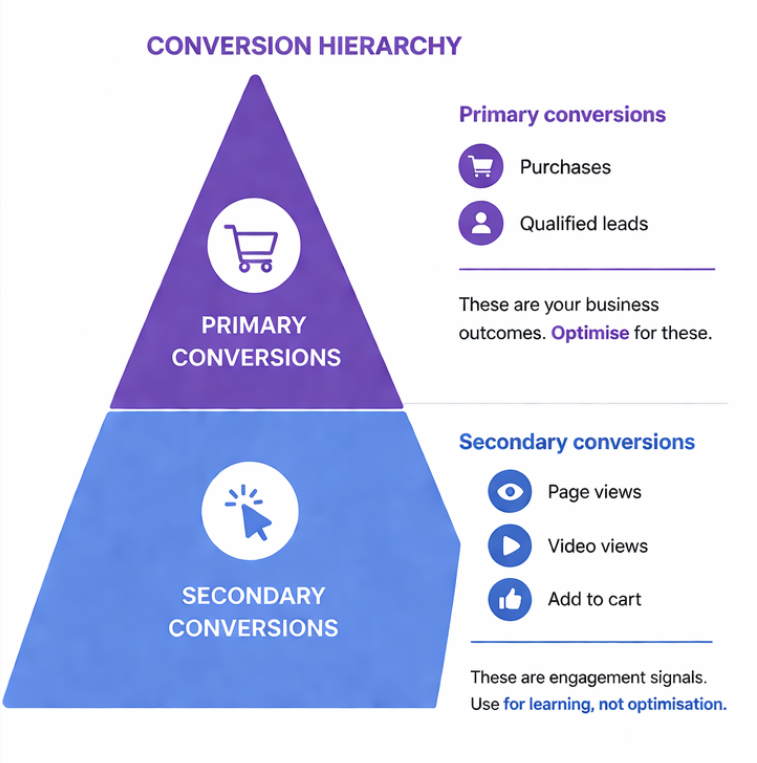
The key shift: move from “a conversion” to a conversion strategy
Instead of treating conversion as a single event, it should be structured as a hierarchy of intent:
This is not just about tracking more - it’s about defining purpose for each signal:
Then ensure your bidding strategy matches this structure:
In short, the goal is not just to track conversions - it’s to design a system of signals that teaches the algorithm what “good” actually means for your unique business.
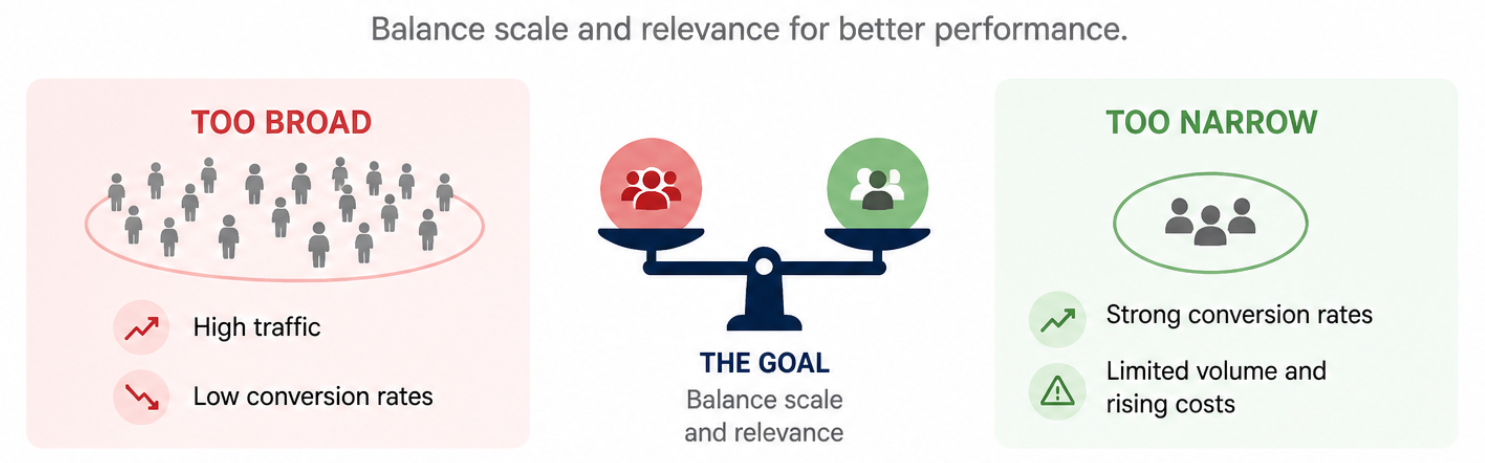
Audience strategy often swings between two extremes: casting the net too wide, or tightening it too early.
Too broad → You get reach, but a large portion of traffic has weak or unclear intent, leading to diluted conversion rates.
Too narrow → You attract highly relevant users, but restrict scale and starve the algorithm of enough data to learn and optimise effectively.
In both cases, performance suffers - but for different reasons. One lacks relevance, the other lacks volume. So what should you do?
Why this matters:
Audience targeting is essentially how you “teach” the platform who your ideal customer is. If the inputs are off, the system will still optimise - but it will optimise within the wrong pool of users. That means even strong creative and landing pages won’t fully recover performance.
This is where many accounts misstep: treating targeting as a fixed setup, instead of an evolving learning system.
What to do instead:
Think of audience strategy as a progression, not a static choice:
The key shift is moving away from “either broad or narrow” thinking, and toward structured expansion with guided focus.
Ultimately, the goal is not to maximise reach or precision in isolation - it’s to find the balance where scale and relevance reinforce each other over time.
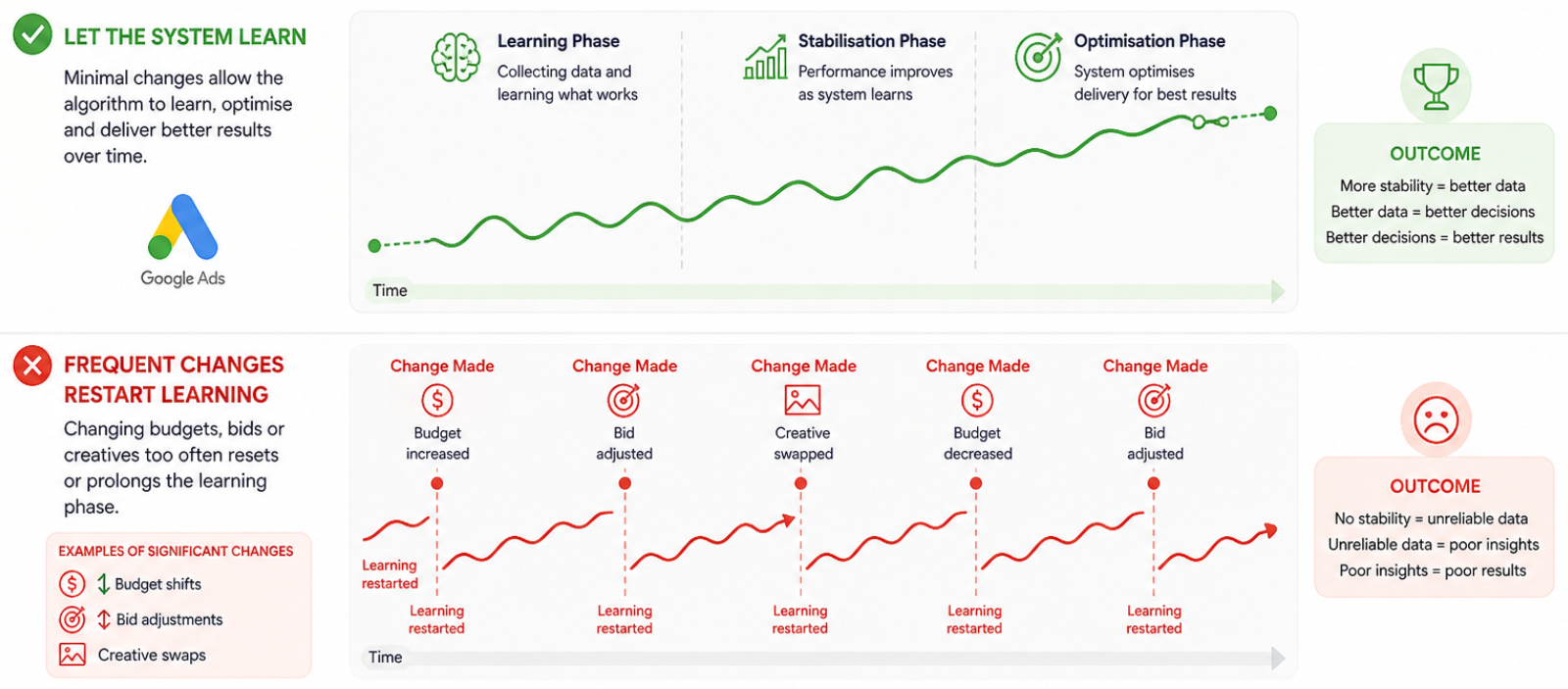
Frequent changes are often mistaken for active optimisation. In reality, they can disrupt performance.
Every significant change - budget shifts, bid adjustments, creative swaps - resets or prolongs the learning phase. If changes are made too often, campaigns never stabilise long enough to generate reliable insights.
Why this matters:
If changes are made frequently, it becomes difficult to distinguish whether performance shifts are due to the change itself or simply the system is still learning. This often leads to a cycle of reactive optimisation - where one adjustment triggers another - without ever allowing enough time for stable performance to emerge.
What to do instead:
Introduce structured testing discipline:
Effective optimisation is not about constant intervention. It’s about creating enough stability for the system to learn properly, so that when you do make changes, you can confidently interpret their impact.
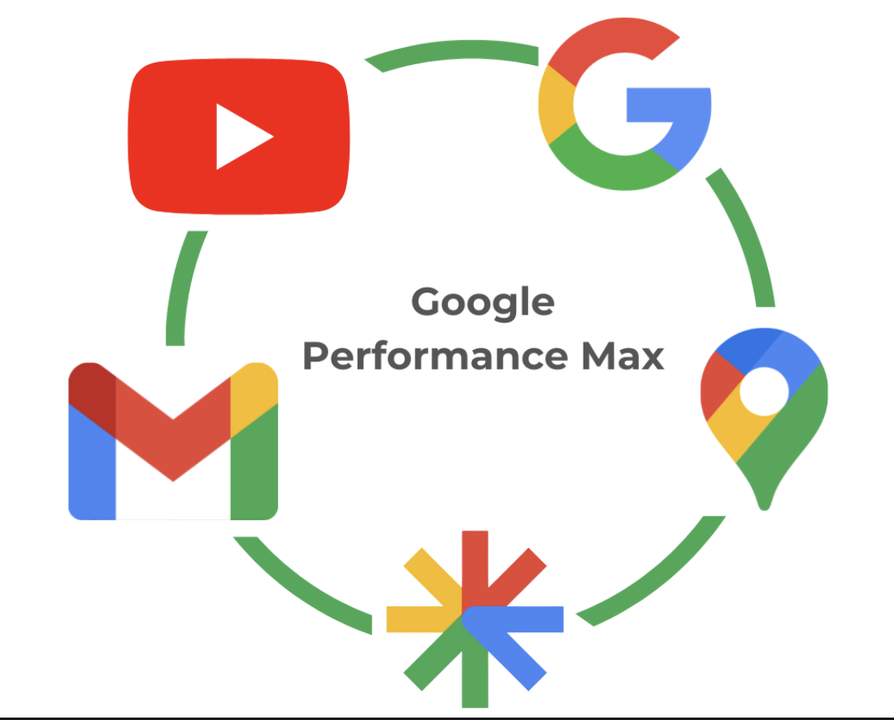
Automation has transformed digital advertising, but it’s not a substitute for strategy.
Campaign types like Performance Max (PMax) offer scale and efficiency, but they also reduce visibility and control. Many advertisers rely too heavily on these solutions without fully understanding how they operate or what inputs they require.
Why this matters:
Automation does not “fix” performance problems - it amplifies whatever it is given.
If the inputs are strong (clear conversion signals, well-structured tracking, compelling creatives, and relevant audience signals), automation can scale success efficiently. If the inputs are weak or misaligned, it will scale inefficiencies just as effectively.
What to do instead:
Use automation as a tool, not a crutch:
A hybrid approach often delivers better long-term results than full automation alone.
While Google Ads provides strong campaign-level performance data, it often stops short of explaining why users do not convert after clicking. This is where GA4 becomes essential as a complementary layer of analysis.
GA4 enables you to move beyond surface-level metrics and examine user behaviour across the entire journey, from initial landing to conversion.
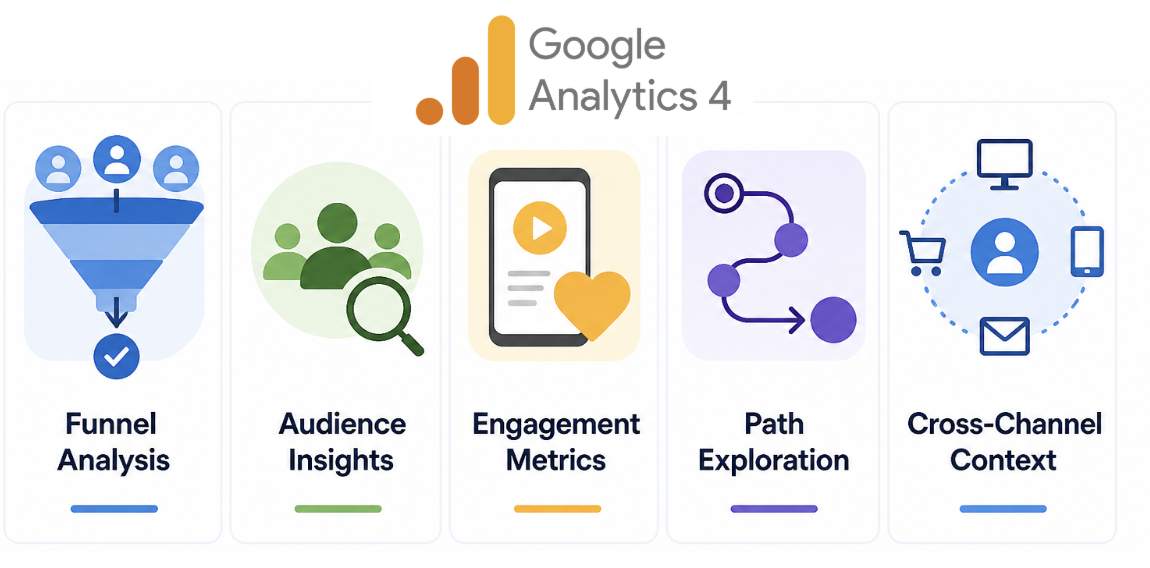
Key ways GA4 adds value in your observations/analysis:
a. Funnel analysis
Identify exactly where users drop off between landing and conversion. For example, are users abandoning forms, exiting product pages, or failing to progress past key steps?
b. Audience insights
Understand which user segments actually convert, not just which ones generate clicks. This helps refine targeting, bidding, and messaging strategies in Google Ads.
c. Engagement metrics
Metrics such as engagement rate and average engagement time help distinguish between high-intent users and low-quality traffic that may only be briefly interacting with the site.
d. Path exploration
Visualise the real sequences users take before converting - or dropping off. This often reveals friction points or unexpected navigation patterns that are not visible in ad platforms.
e. Cross-channel context
Conversions rarely happen in isolation. GA4 helps you understand how paid search interacts with other channels such as organic search, direct traffic, and email, giving a more complete view of contribution and influence.
When Google Ads campaigns underperform, the instinct is often to adjust bids, refresh creatives, or increase budgets. While these actions have their place, they don’t address the root causes outlined above.
More often than not, performance issues stem from the common mistakes outlined above.
Addressing these fundamentals requires a more deliberate, data-informed approach - one that combines platform expertise with behavioural insights from GA4.
By stepping back and diagnosing the underlying issues, you can shift from reactive optimisation to strategic improvement - and ultimately turn traffic into meaningful conversions.
If you’re currently refining your Google Ads/GA4 strategy or need support getting started, Ayudante APAC can help. Reach out to us at info@ayudante.asia for more information.