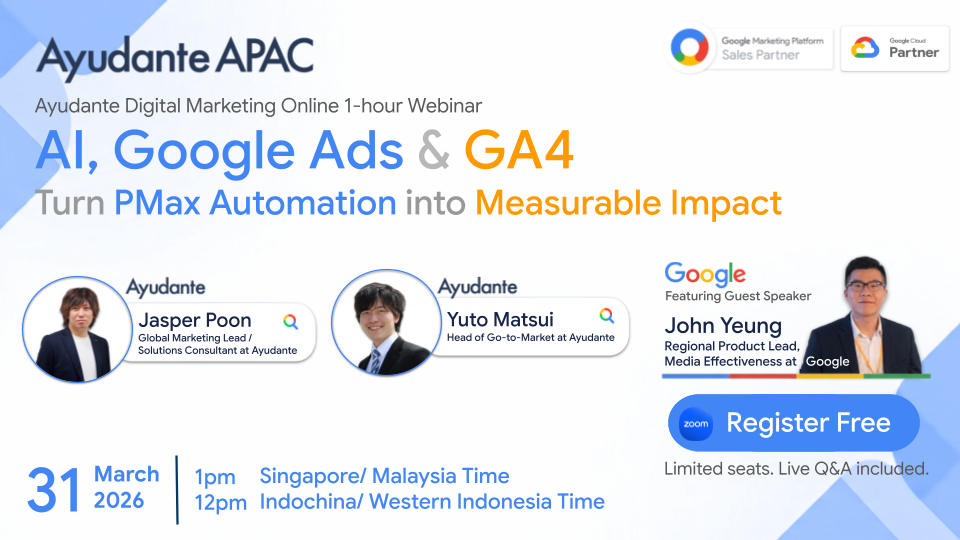
AI is everywhere in digital marketing today. From Performance Max campaigns to automated bidding and creative generation, many marketers are already relying on AI to run their campaigns.
But at the same time, many are asking the same question:
“If AI is so powerful, why are my campaign results still inconsistent?”
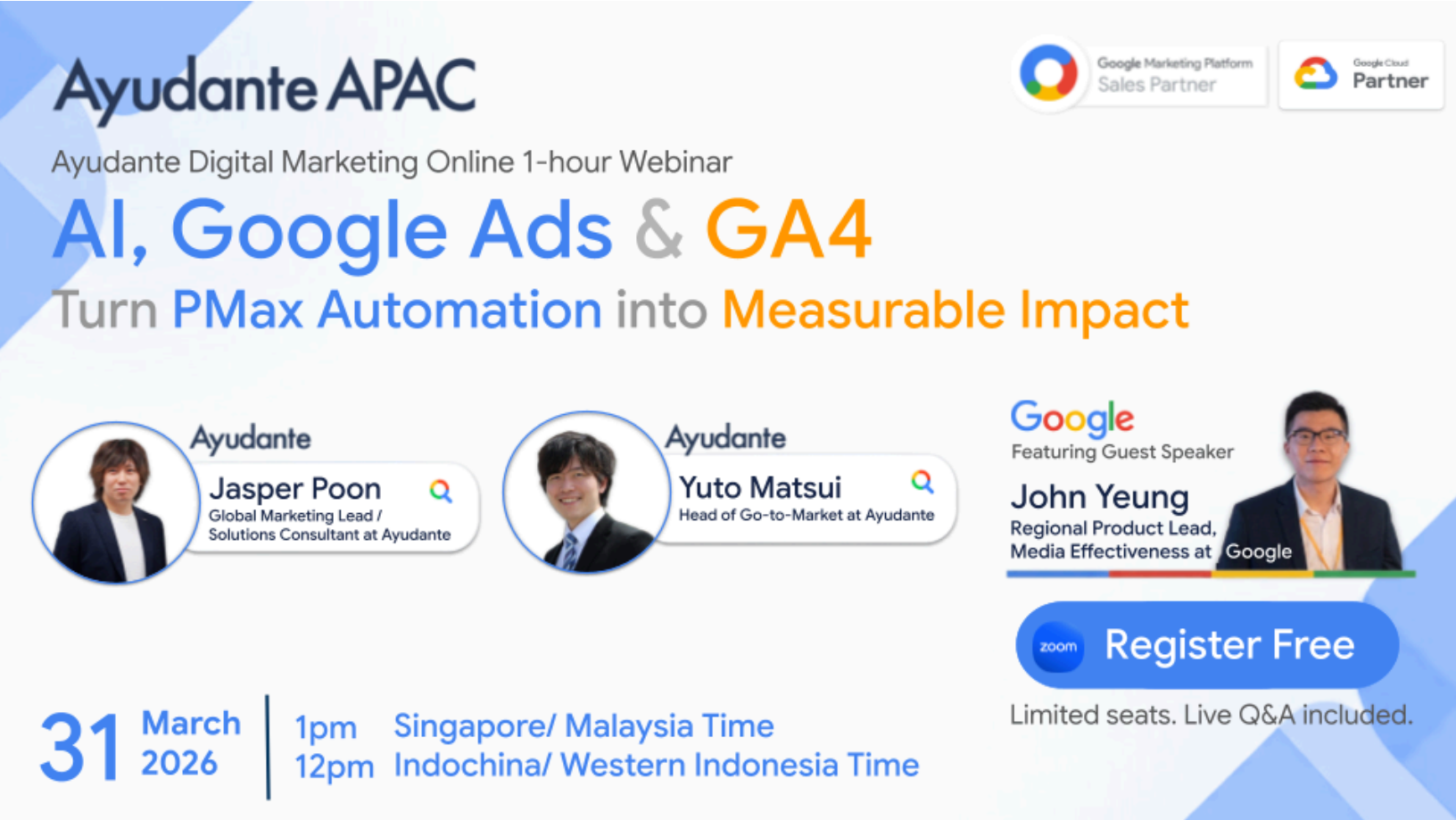
This was exactly what we set out to explore in our recent Ayudante webinar.
I had the pleasure of hosting this session together with:
The goal of this session was simple: To understand how AI-driven campaigns actually work and why measurement is the key to making them successful.
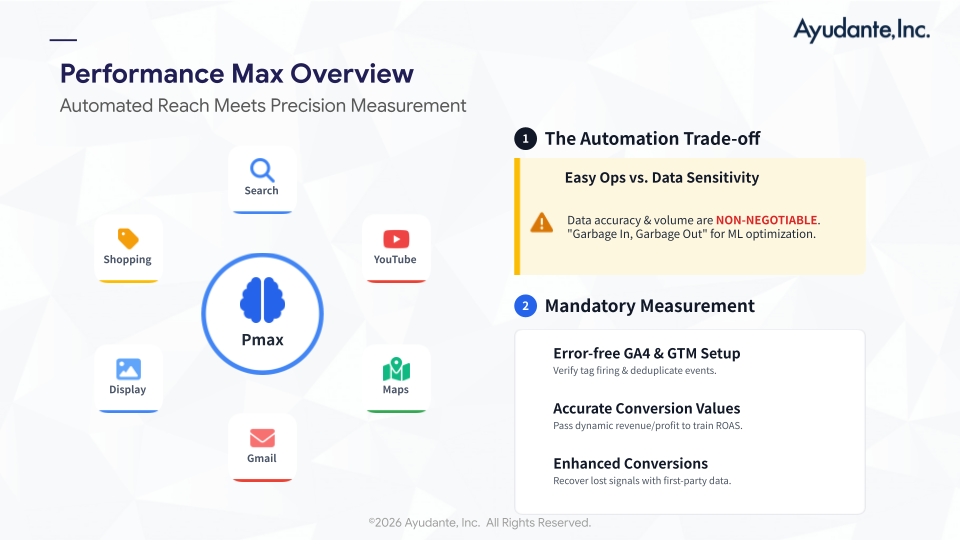
Yuto kicked off the session by explaining why Performance Max has become so popular.
PMax was designed to simplify campaign management by:
In fact, to launch a PMax campaign, you only need three things:
It sounds simple — and it is.
But there is a trade-off:
Automation makes execution easier, but it also reduces control.
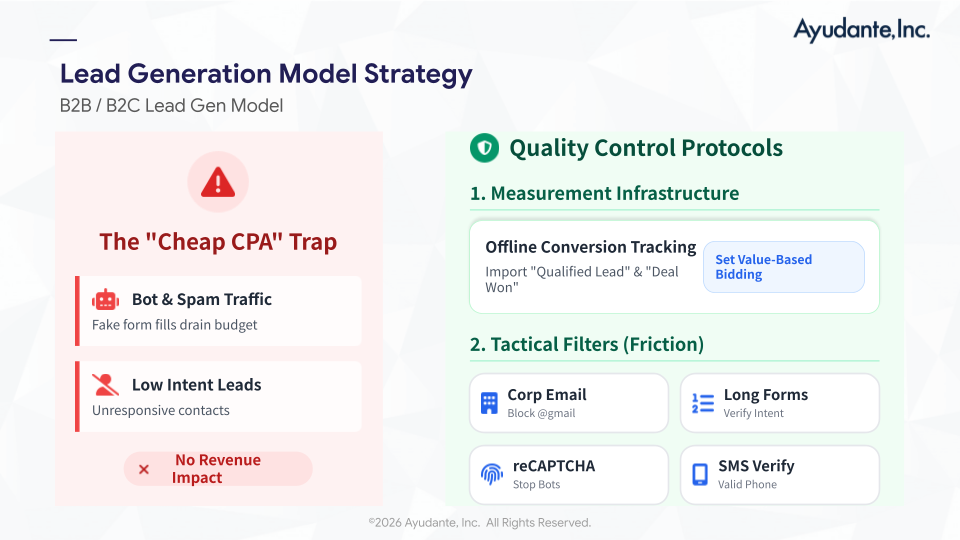
One of the most important points from Yuto’s session was this: AI does not understand your business goals. It only optimises based on the signals you provide.
For example, in lead generation:
In eCommerce:
The problem is not AI.
The problem is what AI is learning from.
Without high-quality input, AI doesn’t stop, it simply keeps optimising in the wrong direction. Your ad budget gets distributed broadly, often randomly, outcomes drift away from what actually matters, and performance becomes unstable over time.
But when the data is strong, the behavior changes entirely.
AI learns faster, identifies better users, and improves efficiency in a much more meaningful way. In that sense, AI is not lacking capability, it’s lacking fuel. And this is exactly where Google Analytics (GA) starts to change the game.
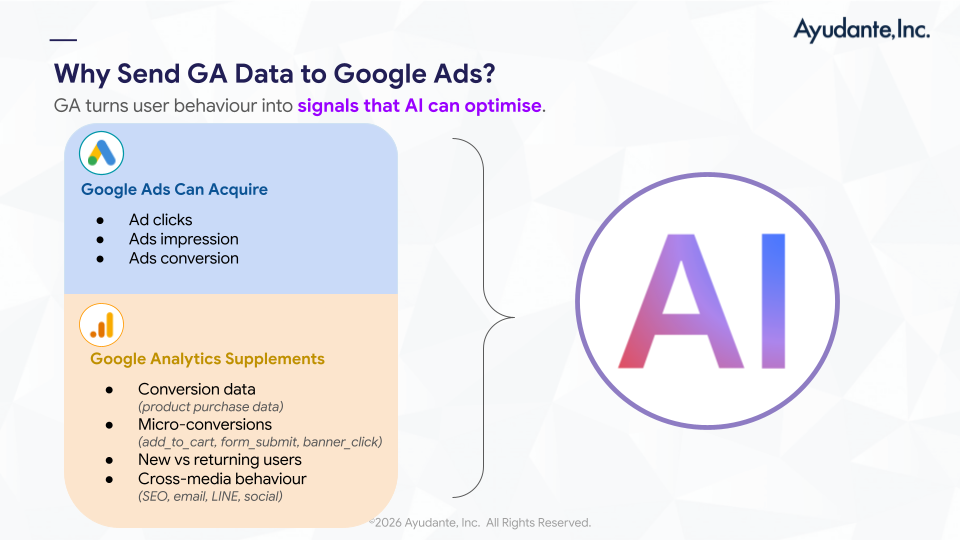
In the second part of the session, I focused on one key idea: AI performs only as well as the signals it receives.
Google Ads vs Google Analytics (GA) are actually Two Different Views.
Google Ads tells you: What happened before the click
Impressions, clicks, campaigns
GA tells you: What happens after the click
Behavior, engagement, conversions
When Combined, AI Sees the Full Picture.
When you connect GA4 with Google Ads, AI starts to understand what users actually do, not just what they click. It learns from real behavior, sees the full journey, and optimises with much better accuracy.
Without this connection, PMax is essentially operating blind.
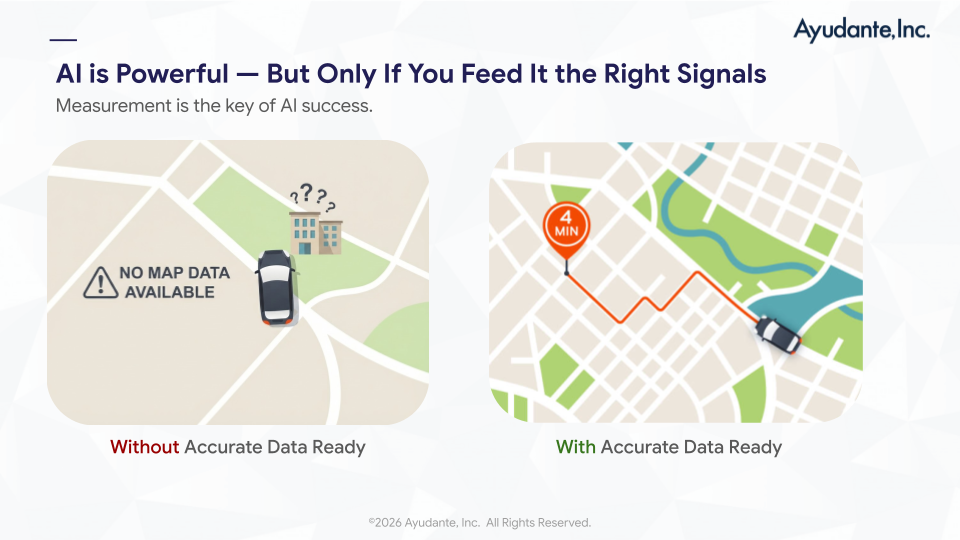
AI optimisation in Ads operation follows a simple process.
But this only works if the initial signals are strong. If the data is weak or incomplete, the entire process struggles, this is why some campaigns perform well while others don’t.
A simple way to think about it:
Running PMax without proper data is like driving without a map.
You have a destination and a budget, but,
without traffic information and map, you end up wasting time and resources,
and may never reach where you want to go.
When we provide strong signals: behaviour data, conversion data, and identity signals.
Then, AI can finally see the road clearly and optimise much more effectively.
Automation is only as good as the inputs.
The question is no longer whether your campaign setup is good, or whether the AI is smart enough.
It is this:
Are we giving AI enough signals to truly understand our customers?
The questions from the audience were some of the most practical and honest we’ve seen. A few highlights included:
Q: How do we automate and maximise the effectiveness of Google Ads?
Yuto: It’s not about full automation — it’s about balance. Automation like PMax is powerful for discovering new demand (“blue ocean”), but manual campaigns are still critical in competitive markets (“red ocean”), especially for precise keyword control and cost efficiency.
So, use PMax for exploration, and manual campaigns for control — the best results come from combining both.
Q: What are the most effective ways to strengthen audience signals beyond basic GA4 integrations?
Jasper: It comes down to signal quality and completeness. Many teams focus only on conversion data, but non-converted signals are just as important.
User behavior, like page views, engagement, and drop-offs, helps AI understand intent, not just outcomes. On top of that, improving data granularity and using identifiers like user ID allows AI to connect these signals into a full journey.
So it’s not about more data: it’s about better, more connected data.
Q: What strategies can ensure Paid Search visibility when AI Overviews dominate the SERP?
John: This is not about losing visibility, it’s about adapting to a new search experience. AI Overviews change how users interact with results, but they still rely on strong underlying content and signals. Paid and organic strategies need to work together, because visibility now extends beyond traditional placements.
So the focus should shift from ranking positions to overall presence in the information ecosystem.
Q: What are the risks of relying too much on AI?
John: The biggest risk is brand control. AI can scale and optimise, but it doesn’t fully understand your brand, which can lead to misaligned messaging or lack of proper guardrails. At the same time, AI doesn’t question your assumptions. It simply follows the inputs you give it.
So the risk is not AI itself, but using it without enough control and validation.
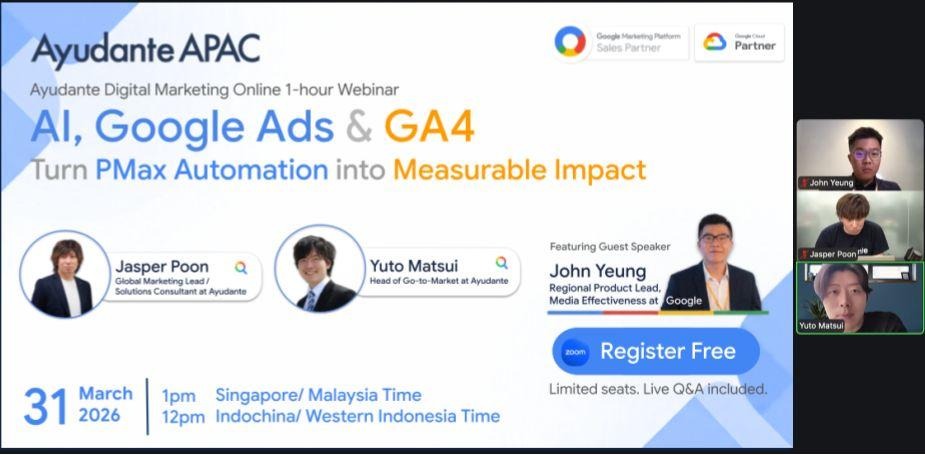
Reflecting on the session, what stood out most to me was not how advanced AI has become, but how dependent it still is on us.
AI can process, optimise, and scale far beyond human capability, but it does not understand context, intent, or responsibility. It works with what it is given. And in many ways, that makes our role even more important, not less.
Whether it is campaign setup, data quality, or defining what success actually looks like, these are still human decisions. If those foundations are unclear, no level of automation can truly fix the outcome.
Perhaps that is the real shift we are seeing.
Not from manual to automated marketing, but from execution to judgement.
AI is undoubtedly powerful, and it will continue to evolve. But it is not something we hand over control to. It is something we guide, validate, and continuously learn alongside.
In many ways, working with AI today feels like driving with auto-pilot.
It can take you far, and sometimes faster than you expect, but only if you give it the right direction.
Without that, it doesn’t fail.
It simply keeps moving.
And that, perhaps, is where the real responsibility lies.