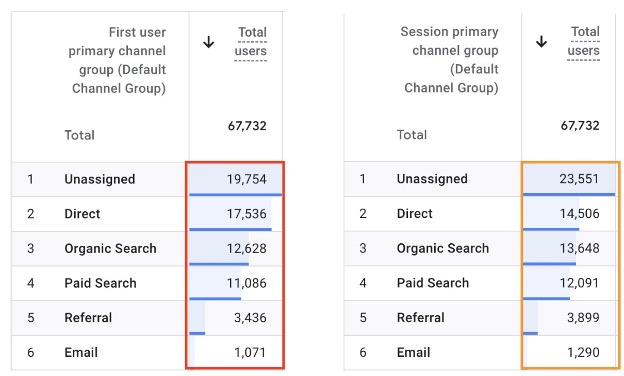
Imagine you're preparing a monthly marketing report.
You open GA4 and see that Organic Search generated 150 conversions in the User Acquisition report.
Then you switch to Traffic Acquisition and find only 95 conversions attributed to Organic Search.
To make things even more confusing, Google Ads reports a completely different number.
At that point, most marketers assume one of three things:
In most cases, none of those explanations are true.
One of the most common issues we encounter during GA4 audits is teams comparing reports that were never designed to match. The reports are often accurate—but they're answering different questions.
Understanding that distinction is the key to making sense of attribution in GA4.
Before diving into attribution models and reporting logic, it helps to understand a simple concept:
The same conversion can be viewed through multiple lenses.
The conversion happened once, however what has changed is the reporting perspective.
This simple distinction explains a large percentage of the attribution confusion marketers experience in GA4.
Many people assume attribution works like this:
A user came from Google, made a purchase, and therefore Google should get credit for the conversion.
Real customer journeys rarely work that way.
Consider this example:
Which channel deserves credit?
There isn't a single universally correct answer.
The answer depends on the question you're trying to answer and the attribution model being used. This is why attribution exists in the first place. Marketing channels often work together to generate conversions, and different reports evaluate those contributions from different perspectives.
Before discussing attribution models, it's important to understand another concept that frequently causes reporting differences: scope.
GA4 stores and reports data across different levels.
User-scoped reports focus on how someone first discovered your business.
Question being answered:
How did we acquire this user?
This is the perspective used in User Acquisition reporting.
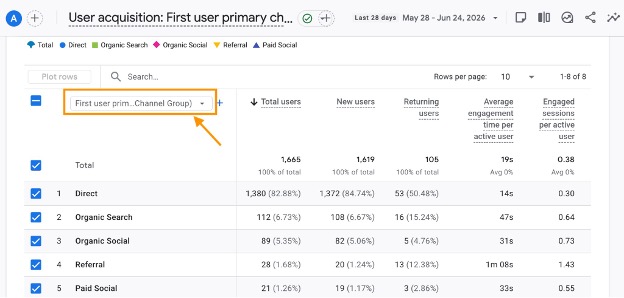
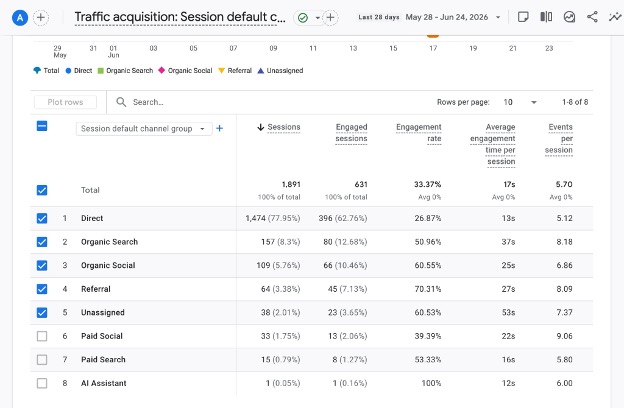
Session-scoped reports focus on the traffic source associated with a specific visit.
Question being answered:
What channel drove this session?
This is the perspective used in Traffic Acquisition reporting.
Attribution reports focus on conversion paths and the marketing interactions that influenced a conversion.
Question being answered:
Which channels contributed to this outcome?
Once you understand that these reports operate at different scopes, the reporting differences become much easier to explain.
(In-depth article on scopes can be found HERE)
This is probably the most common GA4 reporting discrepancy.
Suppose a user:
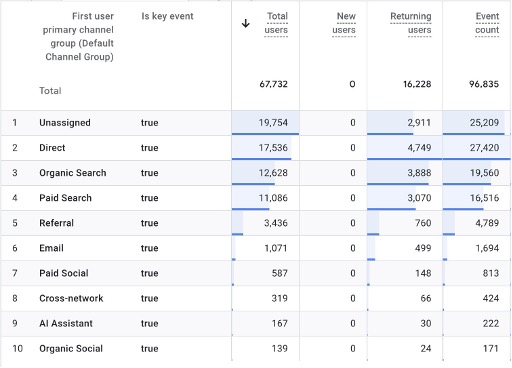
The same conversion may appear differently depending on the report.
Nothing is wrong with the data. The reports are simply looking at the customer journey through different lenses:
The conversion happened once. The interpretation changes.
User Acquisition report:
Traffic report:
The conversion occurred once, but different report scopes result in different attribution outcomes.
This is often the first report comparison we review when stakeholders believe GA4 is "reporting incorrectly." In reality, the reports are measuring different aspects of the customer journey.
Another major source of confusion is GA4's default attribution model: Data-Driven Attribution (DDA).
In older analytics setups, marketers often relied on Last Click attribution.
Under Last Click, the final interaction before conversion receives all the credit.
For example:
Under Last Click attribution:
Data-Driven Attribution works differently.
Instead of assigning all value to a single interaction, Google's machine learning models analyze historical conversion paths and estimate how much each touchpoint contributed to the outcome.
A simplified example might look like:
The exact percentages vary based on your data, but the principle remains the same.
GA4 assumes marketing channels work together rather than treating the final interaction as solely responsible for the conversion.
As a result, channel performance often looks very different compared to older Last Click reporting models.
Another misconception is that Google Ads and GA4 should report identical conversion totals because both platforms belong to Google.
In reality, perfect alignment is uncommon.
Some of the most common reasons include:
Google Ads and GA4 may assign conversion credit differently.
Each platform can use different lookback periods when evaluating conversions.
A user may interact on one device and convert on another.
The ability of each platform to connect those interactions can vary.
As privacy regulations evolve, both platforms increasingly rely on modeling when direct observation isn't possible.
Those modeling approaches aren't always identical.
Conversion processing and reporting timelines may differ between platforms.
The goal shouldn't be forcing every number to match.
The goal should be understanding why the numbers differ and ensuring those differences are consistent and explainable.
We frequently see stakeholders expect a one-to-one match between Google Ads and GA4. While the platforms should generally trend in the same direction, identical conversion totals are rarely a realistic expectation.
A more useful question than "Which report is correct?" is: Which report answers the business question I'm trying to solve?
Use Attribution reports - These reports help you understand how marketing channels influence conversions across the customer journey.
Use Traffic Acquisition reports - These reports help identify which traffic sources are driving visits and conversions at the session level.
Use User Acquisition reports - These reports show how users first discovered your business.
Use platform-specific reporting such as Google Ads when making campaign management decisions.
Advertising platforms generally provide the most complete view of performance within their own ecosystems.
The biggest attribution mistake isn't choosing the wrong attribution model. It's assuming every report should reconcile to the same channel-level conversion totals. GA4 was designed to provide multiple perspectives on marketing performance.
Different reports answer different questions.
Different scopes produce different interpretations.
Different attribution models distribute credit differently.
Once you understand that, most attributions "problems" stop looking like problems.
When marketers encounter conflicting conversion numbers in GA4, the instinct is often to search for the single correct figure. In reality, the discrepancy is usually the result of reports measuring different aspects of the customer journey.
User Acquisition reports focus on how users were first acquired. Traffic Acquisition reports focus on the source of individual sessions. Attribution reports evaluate how multiple touchpoints contributed to a conversion.
The conversion itself hasn't changed. The analytical perspective has. Understanding that distinction makes GA4 attribution far less confusing and far more useful.
The next time two reports disagree, resist the urge to determine which number is "correct." Instead, determine what question each report was designed to answer. In most cases, the discrepancy isn't a reporting issue—it's a reflection of different attribution perspectives.