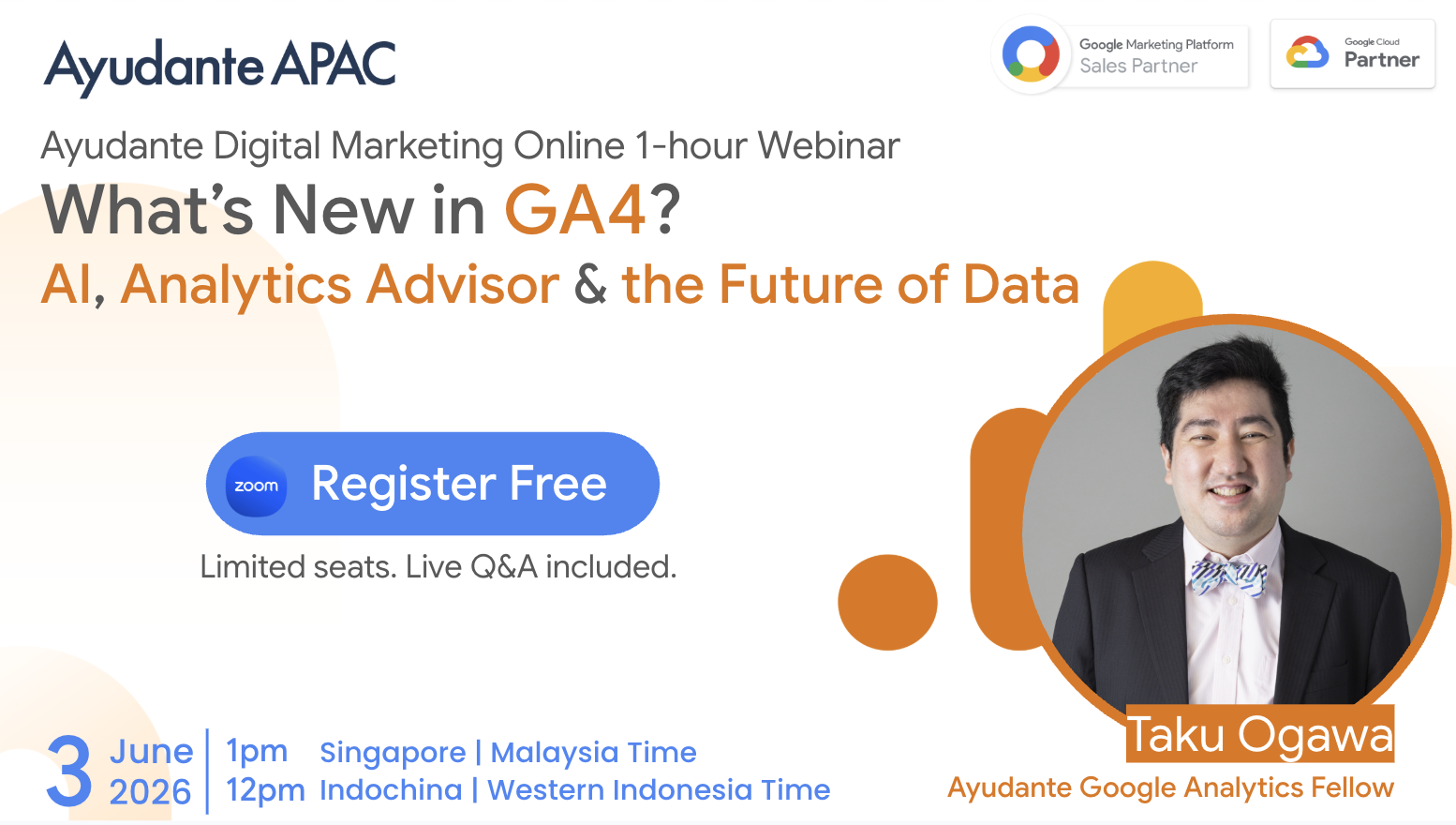
This year, I had the opportunity to speak at Digital Marketing Asia (DMA) 2026 in Bangkok.
Following our session in Singapore last year, this time I took the stage to share my perspective on a topic that continues to shape our industry: The Future of AI-Powered Marketing Measurement starts with building a resilient data foundation for growth.

Today, everyone is talking about AI.
As marketers, we see how it can help us forecast demand, personalise experiences, optimise campaigns, and simulate different scenarios. But during my session, I wanted to bring the focus back to something simple:
AI does not create intelligence by itself.
AI learns from data.
If the data is incomplete or inaccurate,the output will be the same. That is why I emphasised this idea:
Garbage In, Garbage Out — AI is only as good as the data you put into it.
For AI to work properly, it needs two key signals:
Without these, AI cannot see clearly. And without visibility, it cannot make reliable predictions.

At the same time, marketing itself is becoming more complex.
97% of purchase journeys are unique, with up to 30 touchpoints.
(Source: Google / Similarweb Advisory Services. E-commerce Consumer Journey Study, US, 2022, n-consumer conversions across 150+ ecommerce sites representing an estimated 57.7 million conversions, Q1 2022)
Users interact with many channels before converting, making measurement more difficult than ever. But beyond complexity, there is another challenge: we are losing data signals.
Around the world, privacy laws such as GDPR and CPRA are giving users more control over their data. This means marketers now have to balance between performance and privacy compliance. As a result, many traditional tracking methods are becoming less reliable.
At first, it may feel like this only affects Europe or the US.
But that is no longer true.
Across Asia, including Thailand and Singapore, privacy regulations are also evolving.
The region may not be as strict yet —but the direction is clear.
The world is becoming more privacy-centric. And the wave is coming.
But, how do we solve this?

In this new environment, I see GA4 as a key foundation.
But it is not enough on its own. To deal with signal loss, we also need solutions like Consent Mode and server-side tracking to recover missing data.
More importantly, no single solution can solve everything.
It is the combination of these solutions that makes the difference, with GA4 at the centre of the data recovery process.
During the session, I shared a client case from a global airline.
Because of privacy regulations, nearly half of their data became invisible.
Performance looked weaker, and confidence dropped.
After implementing GA4 and Consent Mode, we helped them recover up to 64% of lost conversions, and achieved over 50% up liftin revenue and ROI.
For me, the key takeaway is simple:
We may not see every user anymore.But if we understand patterns, we can still make the right decisions.

Looking back, what stood out to me most was not just the session itself, but the conversations around it. I had the chance to speak with many marketers in Bangkok and better understand the Thai market.
In Thailand, especially with the strong tourism industry, many businesses, particularly hotels, serve customers from all over the world. This means they must meet international privacy standards such as GDPR.
Because of this, I saw a strong awareness around:
And this connects directly to the core message of my session. Without a strong data foundation, AI becomes fragile. But with the right measurement strategy, even in a privacy-first world, AI can still deliver meaningful results.
Personally, I found it inspiring to see how marketers in Thailand are already adapting to this shift in balancing global compliance with business performance.
As someone who strongly believes in the role of AI in marketing, this experience reinforced my view:
The future is not just about using AI.It is about building the right foundation for AI to work.
We look forward to working more closely with marketers in Bangkok and across the region, to build a more data-resilient, privacy-aware marketing ecosystem together.

In addition to the speaking session, Ayudante APAC also participated as an exhibitor at DMA Bangkok 2026. Our booth welcomed marketers from across industries, with many discussions centred around signal loss, privacy compliance, and the growing need for stronger measurement foundations.
We also introduced our Google Analytics Auditor, helping businesses quickly assess their GA4 data readiness for a privacy-first, AI-driven environment, as well as Stape, a server-side tracking solution that supports more robust and reliable data collection.
It was encouraging to see strong interest from the Thai market in building more resilient data strategies. My colleague Jason will be sharing a more detailed article on the event soon…stay tuned!