AI is everywhere right now.
From ChatGPT to Google’s AI Overviews, I believe many marketers are asking the same question:
“Is SEO still relevant in the age of AI?"
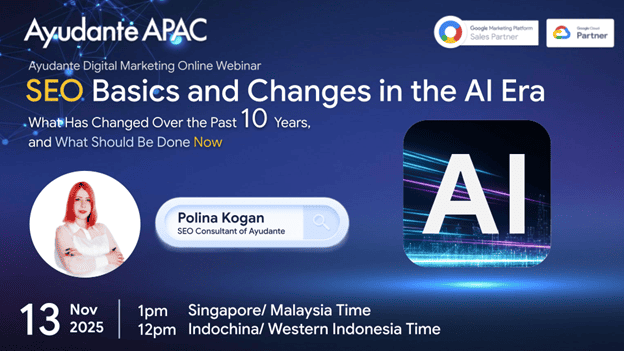
I had the pleasure of hosting the session, joined by Polina Kogan, SEO Consultant at Ayudante, and one of the most experienced voices in SEO and analytics across Japan, APAC, Europe, and North America.
The session, titled “SEO Basics and Changes in the AI Era”, looked back over the past decade of search evolution and, more importantly, clarified what marketers should actually be focusing on today, beyond the noise and hype surrounding AI.

Early in the session, Polina made one point very clear:
“SEO has been declared ‘dead’ for the past 20 years — and yet, it’s still here."
Despite the rapid rise of AI tools, SEOstill accounts for around 90% of global search activity, while traffic from AI tools such as ChatGPT remains under 1% for most websites.
AI matters, but SEO still forms the foundation.

Polina explained that SEO has changed dramatically over the past decade, but not in the way many people think.
In the past, SEO was mostly about:
Today, it is much more about how users behave.
“SEO is no longer about optimising websites for search engines. It’s about optimising websites for users.”
Google now looks closely at:
If users find your site helpful, Google notices.

Another major theme was E-E-A-T:
In a world full of AI-generated content, Google is placing even more importance on trustworthy sources.
“Google doesn’t justwant popular sites, it wants sites it can trust.”
Trust, or trustworthiness, means:

AI tools like ChatGPT, Gemini, and Perplexity are growing fast — but Polina made an important clarification:
“Most AI tools still rely on traditional search engines.”
In simple terms:
Even Google’s own team has stated that you don’t need special ‘AI optimisation’ tactics for Google AI Overviews, you need solid SEO fundamentals.
The questions from the audience were some of the best we’ve received in any webinar to date. A few highlights included:
Q: Is ChatGPT weakening Google Search?
Polina: At the moment, ChatGPT is more of a complement than a replacement. People often use AI tools to get quick answers, but then return to Google to verify information or explore further. Google search usage is still very strong, and most users are using both together.
Q: What is the biggest impact of AI compared to traditional SEO?
Polina: The biggest change is how people search. Users are no longer typing short keywords, they are asking full questions in natural language. This means websites need to cover topics more thoroughly and answer related questions, not just focus on one keyword. AI has accelerated this shift, but the principle has been there for a long time.
Q: How can our website appear as a source in AI answers like ChatGPT or AI Overviews?
Polina: There’s no shortcut. Most AI tools still rely on traditional search engines. If your SEO fundamentals are strong and your content is trustworthy, you are more likely to be picked up. One important technical point is that some AI crawlers cannot read heavy JavaScript, so your core content must be accessible without it.
Q: What does “killer content” mean in the AI era?
Polina: It means content that fully helps the user. AI systems don’t just answer one question, they try to anticipate the next question as well. Websites that cover a topic deeply, clearly, and honestly are more likely to be featured. There’s no formula, you need to genuinely understand your users.
Q: What’s next for SEO and AI?
Polina: We don’t know exactly, and neither does Google. But the core principles will stay the same. Help users, make your content accessible, don’t over-rely on technology like JavaScript, and be present where your users are. SEO isn’t ending, it’s continuing to evolve.

If there is one thing I took away from this session, it is that AI has not taken search away, it has simply changed how people interact with it.
The drop in traffic many of us see today is largely driven by the short-video era. Users often feel satisfied after quick, engaging content, whether that appears in videos, AI Overviews, or richer search results. This is a shift in behaviour, not the end of search.
AI and SEO are not enemies.
In fact, AI depends heavily on SEO. Google’s AI systems still rely on its top search results. If you want AI tools to pickup your content, strong SEO foundations are still essential.
As Polina explained so clearly, SEO is never a quick fix. It is about trust, engagement, and creating content people actually want. In many ways, it is closer to digital PR than a set of technical tactics.
Coming from a measurement background, I look at traffic and user behaviour every day. Learning SEO gives me a much widerview of what those numbers really mean, and Polina’s explanations made those connections easier to see.
I closed the session with an analogy I often use:
”Ads bring people to your shop. SEO is how people feel about your shop.”
You cannot pay people to like your store, you earn that by offering a good experience. If people leave quickly, the problem is not the ad; it is the shop. The same applies to websites.
AI does not change this.
It makes us more efficient, but it still relies on good content and a strong reputation.
In the end, thank you for taking the time to read this article. I know it has been a long one.
And a special thank you to my teammate Polina for sharing her experience so openly. I have known Polina for some time now, but it is always impressive to learn from someone you already know well, especially someone who has a rare ability to explain SEO in a way that clicks instantly for digital marketers!