AI-powered search is changing the way people discover, consume and engage with information online. From Google's evolving search experience to AI-powered platforms and Large Language Models (LLMs), businesses are facing new questions about how to remain visible in an increasingly complex search landscape.
Along with these changes has come a wave of new terminology, tactics and advice around AI Search, LLMO, GEO, AEO and the future of SEO. But with so much information — and misinformation — circulating, many marketers are asking the same question: With AI transforming search so quickly, what should we actually be doing — and which tactics are simply a waste of time and money?
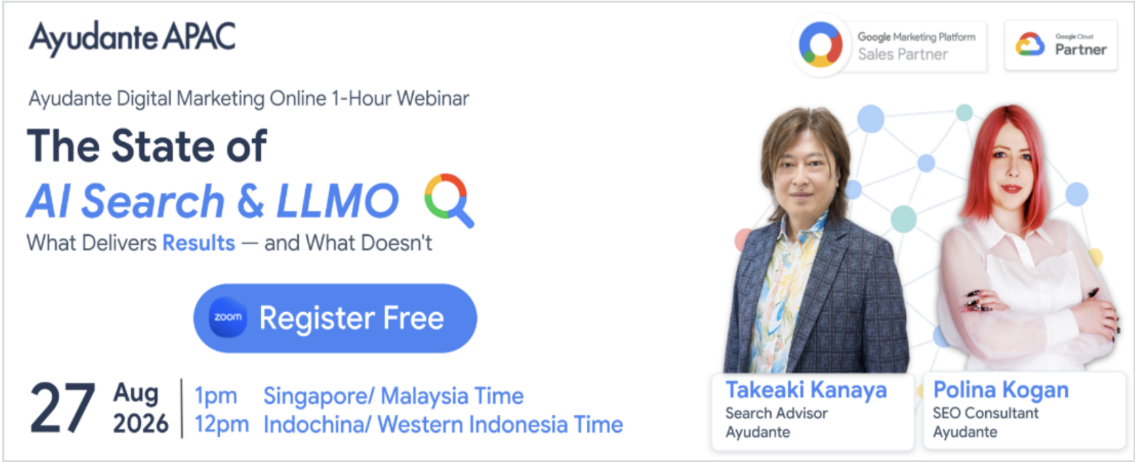
This was exactly the question explored in Ayudante's latest August webinar, The State of AI Search & “LLMO”: What Actually Works — and What’s a Waste of Time and Money.
Hosted by Jasper Poon, alongside Takeaki Kanaya, former member of Google's Search Central team with over 16 years of experience at Google, and Polina Kogan, SEO Specialist at Ayudante, the session examined what is really changing in search and where businesses should focus their efforts.
Rather than following every new AI trend, the discussion focused on sustainable search visibility, the relationship between SEO and LLMO, and how marketers should think about performance as search behaviour evolves.
To kick off the session, Takeaki Kanaya shared his perspective on one of the biggest questions facing marketers today: What is actually happening to search in the age of AI?
Search has remained one of the most important digital marketing channels for years. Even when social media emerged, it did not replace search; instead, it became another channel alongside it.
AI, however, is different. Generative AI is not simply creating another channel outside of search. It is increasingly changing the search experience itself.
Google's AI-powered search features, including AI Overviews and AI Mode, are becoming increasingly integrated into how users search and discover information.
AI Overviews provide AI-generated summaries directly within search results, while AI Mode allows users to explore topics through a more conversational experience and ask follow-up questions. As Kanaya explained, these are no longer simply experimental features — AI is becoming a core part of the search experience.
This shift is also happening across Southeast Asia, with AI-powered search experiences expanding across markets including Singapore, Malaysia, Indonesia, the Philippines, Vietnam and Thailand. With strong interest in AI across the region, businesses should expect AI Search to increasingly influence how their audiences discover information.
The question is therefore no longer whether AI will influence search, but how businesses should adapt their search strategy as the shape of search changes.
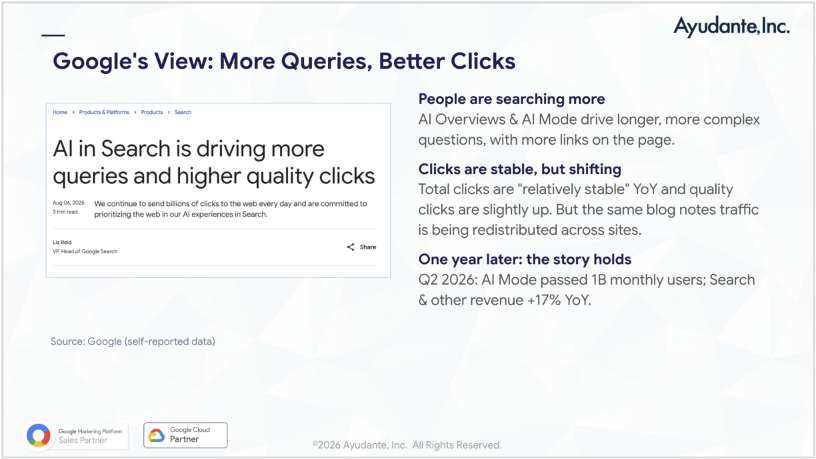
One major concern around AI Search is whether AI-generated answers will reduce organic website traffic. Research suggests click-through rates can decline when AI summaries appear, particularly for informational queries.
At the same time, Google has reported relatively stable overall organic clicks, suggesting the bigger shift may be where traffic goes and which content earns clicks.
Generic informational content may see fewer visits, while websites offering original insights, first-hand expertise and deeper information can remain valuable.
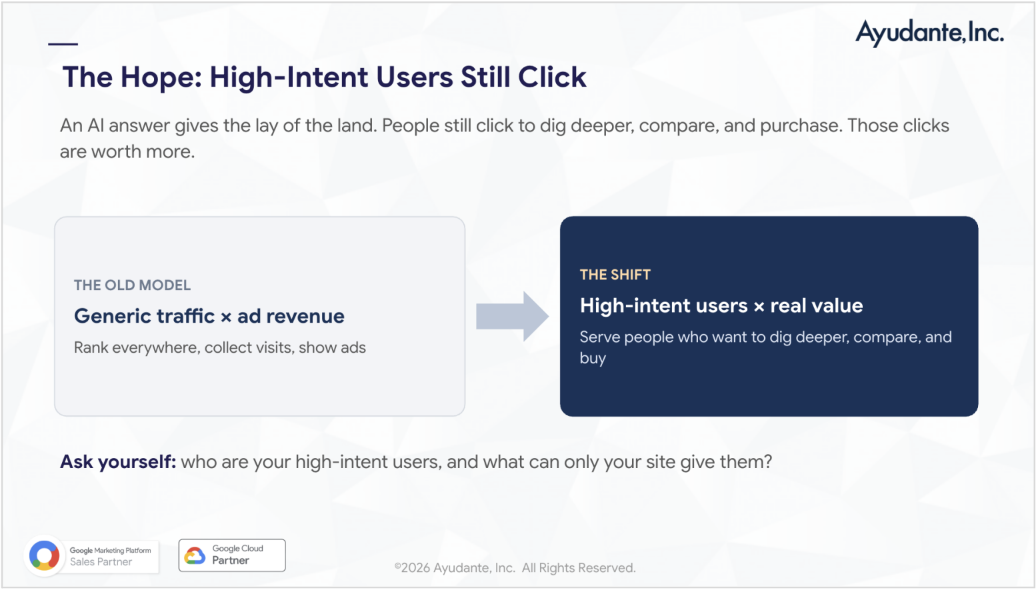
The key question for businesses is therefore not simply “How do we get more traffic?” but “Which users are still clicking — and why?”
As AI becomes better at answering straightforward questions, generic content may become less valuable. Websites can stand out by offering what AI-generated answers cannot easily replicate — first-hand experience, original analysis, unique insights or an authentic perspective.
This also means shifting focus from traffic volume to high-interest users who want to explore, compare, validate or make a decision. These users are still likely to click when a website offers something genuinely valuable.
Who are your high-interest users, and what can only your website give them?
The rise of AI Search has also brought new terminology such as LLMO (Large Language Model Optimisation), GEO (Generative Engine Optimisation) and AEO (Answer Engine Optimisation).
With new agencies and services emerging around these concepts, an important question follows: Is LLMO really a new discipline, or is it largely an extension of SEO?
Kanaya's advice was to avoid becoming too focused on labels and instead look at the underlying principles. Regardless of what the strategy is called, businesses should focus on creating valuable content and building a credible presence that search engines and AI systems can understand.
Following Kanaya's overview, Polina Kogan looked more closely at the growing LLMO industry and what businesses should realistically consider investing in.
Over the past year, there has been a surge of agencies promoting LLMO and GEO services, sometimes alongside claims that “SEO is dead” and businesses should shift their resources entirely towards AI.
Polina's advice was to be cautious about confusing new terminology with an entirely new strategy.
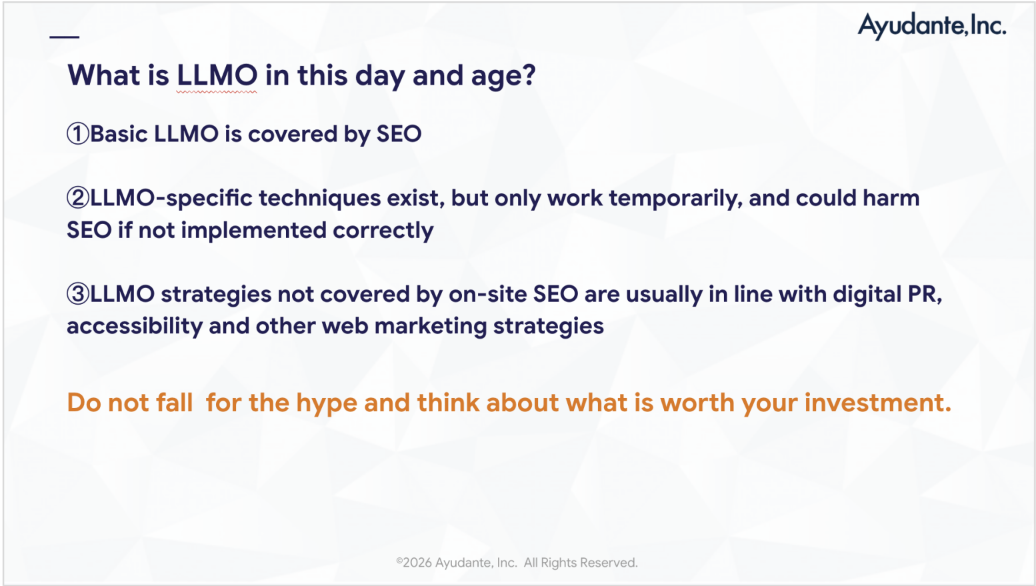
For most businesses, LLMO remains closely connected to SEO. Many so-called LLMO tactics — from technical optimisation and structured data to making content easier to crawl — are already part of good SEO practice.
If your SEO foundation is strong, you may already be covering much of what is needed for AI Search visibility.
Before investing in LLMO services, ask: Does this add genuine value, or simply repackage existing SEO practices?
Polina also highlighted that not every new LLMO recommendation is worth implementing. Some tactics have limited evidence of impact across major AI platforms and may not justify the technical effort required.
The key is to prioritise proven improvements, monitor emerging techniques, and avoid diverting resources from more important SEO or technical priorities.
Before implementing any tactic, consider whether the expected value justifies the time and development resources involved.
Despite the rapid growth of AI platforms, AI-driven traffic remains relatively small compared with traditional Google Search for many websites — often less than 1% of total traffic. Even major news publishers, whose content is frequently cited or referenced by AI platforms such as ChatGPT, may see AI-driven traffic account for only around 0.5% of total traffic.
This does not mean businesses should ignore AI Search, but expectations should remain realistic. Being mentioned in an AI-generated answer does not necessarily translate into significant traffic.
Businesses should first define their objective — whether traffic, brand visibility, share of voice or long-term AI Search presence — and choose KPIs accordingly. In some cases, visibility itself may be valuable even without a direct click.
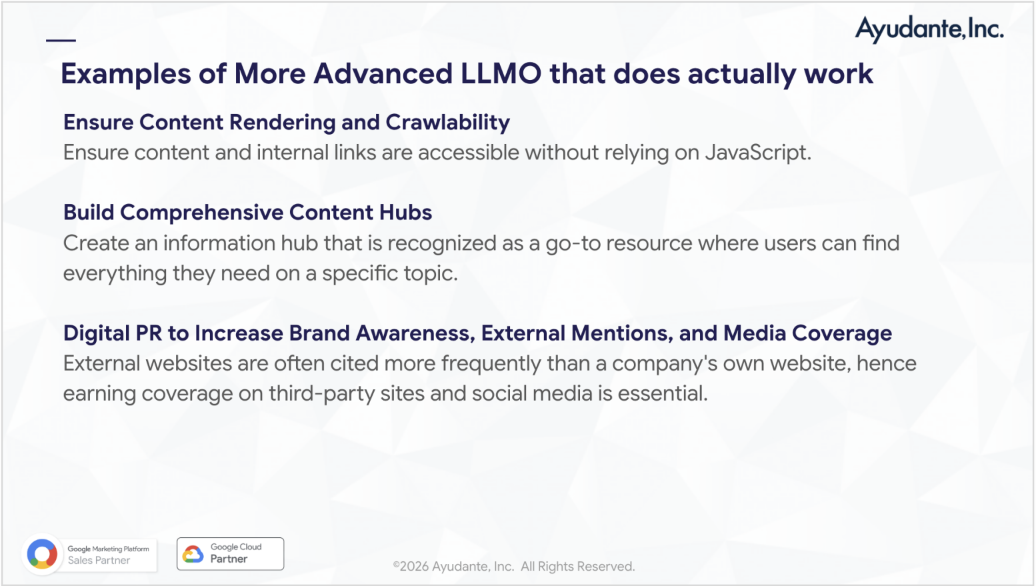
While cautioning against hype, Polina highlighted a few areas where more advanced LLMO work can provide genuine value:
1. Content accessibility & rendering
AI crawlers may process websites differently from Google, particularly JavaScript-heavy sites. Reviewing how content is rendered and accessed can help improve AI visibility.
2. Building topical authority
Develop comprehensive content around key topics rather than isolated keywords, supported by original research, expert insights or unique information.
3. Visibility beyond your website
AI platforms may reference third-party websites, forums, comparison platforms and other sources. Digital PR and broader web visibility can therefore complement traditional SEO.
Other considerations: These can include strengthening content depth, addressing related topics and questions, and building a more authoritative presence across the wider web.
These are not quick fixes, but longer-term investments in a brand's content quality, accessibility, authority and visibility.
The session concluded with a practical Q&A exploring how newer concepts such as AEO and LLMO relate to SEO, and how marketers should measure visibility and performance as AI Search continues to evolve.
Q: What are the differences between AEO and SEO?
While AEO and LLMO may sound like new disciplines, their fundamentals remain closely connected to SEO. A strong SEO foundation — accessible content, sound technical implementation and useful, relevant information — is still essential for AI Search visibility.
There are additional considerations, such as how AI crawlers process JavaScript-heavy websites and how AI platforms draw information from third-party sources, digital PR and social media. However, businesses do not necessarily need a separate strategy for every new form of search. Strong SEO remains the starting point.
Q: How should marketers measure SEO and LLMO performance beyond rankings, traffic and clicks?
As AI Search evolves, marketers should look beyond traditional SEO metrics. Share of voice can help measure how visible a brand is compared with competitors across search and AI platforms, while server log data and AI bot activity can provide insight into whether AI systems are accessing your content.
Other useful signals include brand mentions, citations and high-intent traffic, giving marketers a broader view of visibility and performance beyond rankings and clicks.
The biggest takeaway from the webinar is not that AI or LLMO is replacing SEO. Rather, the way people search — and how businesses build visibility — is evolving.
AI-generated answers may reduce clicks for simple queries, but users still rely on websites to explore, compare, validate and make decisions.
For businesses, the focus should therefore be on sustainable foundations: strong SEO, useful and authoritative content, credible visibility across the web, and KPIs that go beyond clicks.
As the terminology continues to evolve — from SEO to AEO, GEO, LLMO and beyond — the principle remains the same:
Create genuine value. Make your content accessible. Build credibility. Focus on what your audience actually needs.
If you're looking to strengthen your SEO strategy or explore how you can enhance your digital strategy, the Ayudante team would be happy to help. Contact us at info@ayudante.asia